Jewelry Making Equipment
Improve your jewelry making skills.

Weboldal bejelentése
Szabálysértő honlap?
Kérünk, jelentsd be!
Ügyfélszolgálat
Rolling mills play a critical role in modern metalworking by shaping raw metal into precisely controlled sheets, wires, and strips. From large-scale industrial production to small artisan workshops, rolling mills are valued for their ability to improve surface texture while delivering consistent thickness. As demands for precision, repeatability, and creative freedom increase, rolling mills have become essential tools for enhancing both the functional and aesthetic qualities of metal products.
At the most fundamental level, a rolling mill works by passing metal between hardened rollers that apply uniform pressure. This controlled compression reduces thickness while elongating the material. Unlike hammering or forging, which can introduce uneven deformation, rolling produces smooth, predictable results. This consistency is especially important in applications such as jewelry making, electronics, and precision components, where even minor variations in thickness can affect performance or assembly.
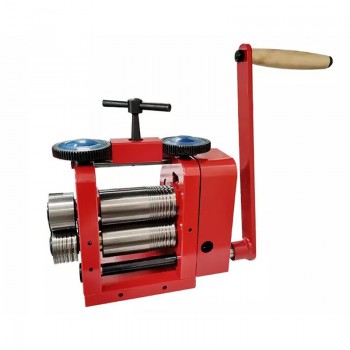
Thickness control is one of the strongest advantages of rolling mills. Adjustable roller gaps allow operators to reduce metal in small, incremental steps. This gradual approach minimizes internal stress and reduces the risk of cracking or warping, particularly when working with softer metals like gold, silver, copper, or aluminum. For harder alloys, controlled rolling combined with intermediate annealing ensures uniform grain structure and mechanical strength. The ability to measure and repeat exact settings also supports efficient batch production and high material yield.
Beyond dimensional accuracy, jewelry rolling mill machines are powerful tools for enhancing metal texture. By using patterned rollers or inserting textured materials—such as fabric, paper, or etched plates—between the metal and rollers, craftspeople can imprint intricate designs directly onto the surface. This process allows for repeatable, high-definition textures that would be difficult or time-consuming to achieve by hand. In jewelry and decorative metalwork, such textures add visual depth and tactile interest without compromising structural integrity.
Rolling also influences the internal structure of metal, which in turn affects surface quality and durability. As metal is compressed, its grain structure elongates and aligns in the direction of rolling. When properly managed, this can improve strength, surface finish, and workability. However, excessive rolling without annealing can lead to work hardening. Skilled operators use rolling mills not just as shaping tools, but as instruments for controlling metallurgical behavior.
Modern rolling mills have further expanded these capabilities through improved materials, tighter tolerances, and motorized operation. Precision-machined rollers, reduction gearing, and digital thickness measurement systems allow for finer control than ever before. These advancements benefit both industrial users and small-scale makers, enabling professional-quality results across a wide range of applications.
In conclusion, rolling mills are far more than simple thickness reducers. They are versatile tools that enhance metal texture, improve dimensional accuracy, and support controlled material transformation. By combining mechanical precision with creative flexibility, rolling mills continue to shape the future of metalworking—one carefully measured pass at a time.
https://www.jewelerstoolsmall.com/goods-1676.html
Honlapkészítés ingyen:
Ez a weblapszerkesztő alkalmas
ingyen weboldal,
ingyen honlap készítés...
Mai: 20
Tegnapi: 16
Heti: 63
Havi: 407
Össz.: 1 942
Látogatottság növelés
Jewelry Making Equipment - © 2008 - 2026 - jewelerstoolsmallus.hupont.hu