Jewelry Making Equipment
Improve your jewelry making skills.

Weboldal bejelentése
Szabálysértő honlap?
Kérünk, jelentsd be!
Ügyfélszolgálat
Induction furnaces are widely used in metal melting and heat treatment due to their efficiency, precision, and cleanliness. However, their performance and safety depend heavily on a well-designed water-cooling system. Without proper cooling, critical components such as induction coils, power cables, and capacitors can overheat, leading to equipment failure, costly downtime, or even hazardous incidents. Therefore, designing an effective water-cooling system and implementing failure prevention strategies are essential for reliable furnace operation.
At the core of any cooling system is the principle of efficient heat removal. Gold melting induction furnaces generate intense localized heat, particularly in the copper coils that carry high-frequency current. To manage this, cooling channels must be carefully engineered to ensure uniform water flow and maximum contact with heat-generating surfaces. Turbulent flow is generally preferred over laminar flow, as it enhances heat transfer efficiency. This can be achieved by maintaining appropriate flow velocities and avoiding sharp bends or restrictions in piping that might reduce performance.
Material selection also plays a critical role. Pipes and fittings should be corrosion-resistant, typically made from stainless steel, brass, or high-quality polymers. In addition, the use of deionized or treated water helps minimize scaling, corrosion, and electrical conductivity issues. Untreated water can lead to mineral deposits inside cooling channels, reducing flow efficiency and increasing the risk of overheating.
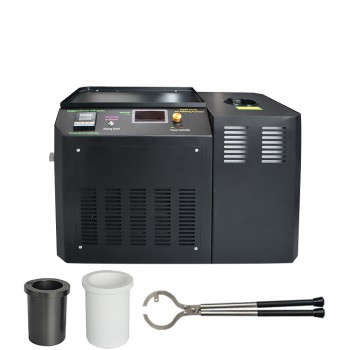
A robust system design must include redundancy and monitoring. Installing flow sensors, temperature sensors, and pressure gauges allows operators to track system performance in real time. Alarms and automatic shutdown mechanisms should be integrated to respond immediately to abnormal conditions such as low flow rates or excessive temperatures. In high-capacity installations, dual-pump systems are often used so that a backup pump can maintain cooling in case of primary pump failure.
Preventive maintenance is equally important in avoiding system breakdowns. Regular inspection of hoses, joints, and seals can help detect leaks before they become critical. Filters should be cleaned or replaced periodically to prevent blockages, and water quality should be tested to ensure it remains within acceptable parameters. Even small issues, such as air bubbles trapped in the system, can reduce cooling efficiency and should be addressed promptly through proper venting.
Another often overlooked aspect is system layout. The distance between the cooling unit and the furnace should be minimized to reduce pressure loss and thermal gain. Proper insulation of pipes can further improve efficiency. Additionally, ensuring easy access to key components simplifies maintenance and encourages routine checks.
Failure prevention also involves operator awareness. Training personnel to recognize early warning signs—such as unusual noise, fluctuating temperatures, or reduced flow—can prevent minor issues from escalating. Clear operating procedures and emergency protocols should be established and regularly reviewed.
In conclusion, the effectiveness of an induction furnace is closely tied to the reliability of its water-cooling system. Through thoughtful design, quality materials, continuous monitoring, and proactive maintenance, operators can significantly reduce the risk of failure. A well-maintained cooling system not only protects valuable equipment but also ensures consistent performance and workplace safety.
Related articles: https://raovat49.com/s/how-to-adjust-power-and-pulse-settings-on-a-mini-jewelry-spot-welder-6447069
Honlapkészítés ingyen:
Ez a weblapszerkesztő alkalmas
ingyen weboldal,
ingyen honlap készítés...
Mai: 8
Tegnapi: 16
Heti: 51
Havi: 395
Össz.: 1 930
Látogatottság növelés
Jewelry Making Equipment - © 2008 - 2026 - jewelerstoolsmallus.hupont.hu